
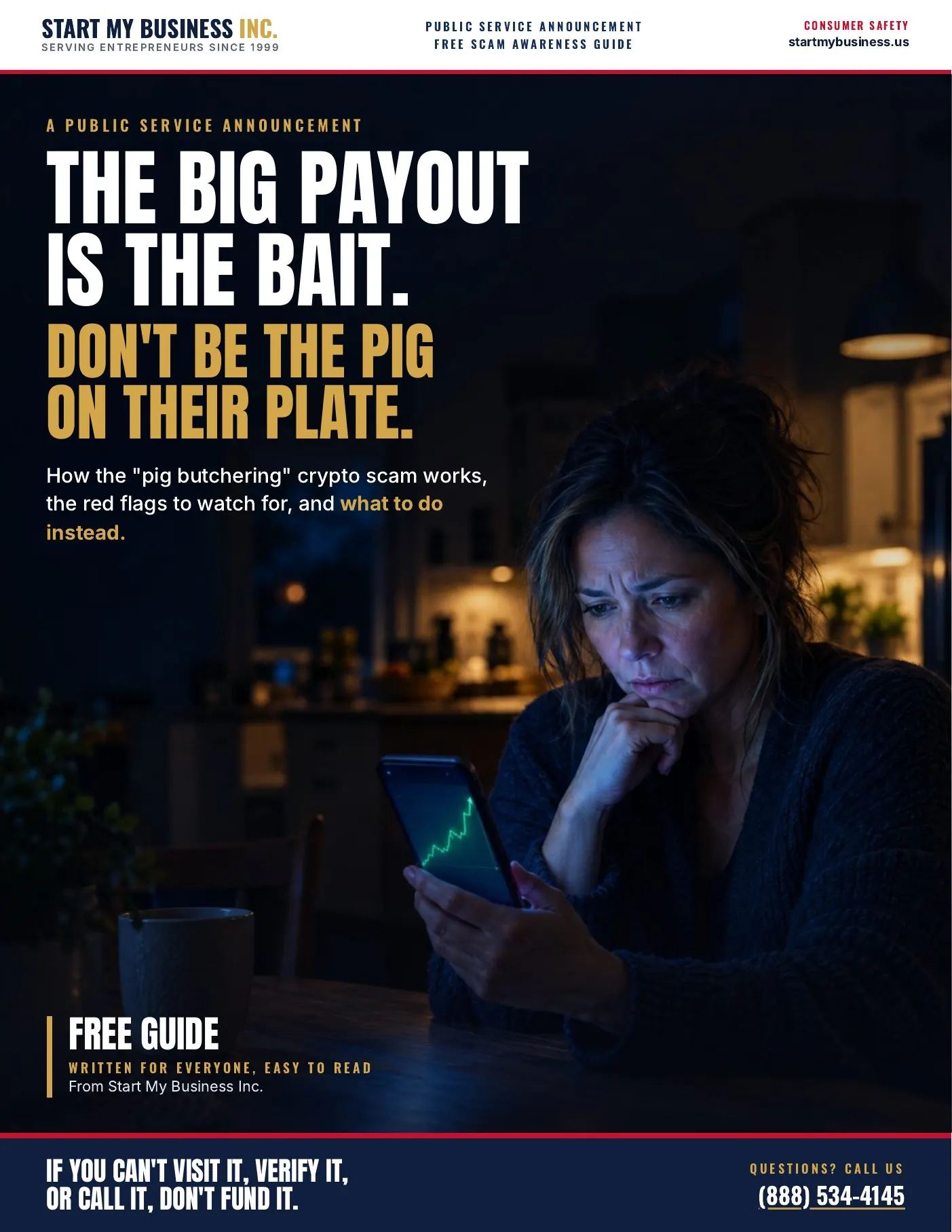
The big payout is the bait. Don't be the pig on their plate.
A free, plain-English guide to the "pig butchering" crypto scam: how it works, the red flags, and what to do instead. No login needed to read it.
Get more free guides
Create your free Start My Business account to unlock our library of free guides on building your life and your business the right way.
Create my free accountAlready have an account? Log in here.Read the guide
All 9 pages are below. Tap a page to zoom, or download the PDF to keep it by your phone.
Want the next guide?
Create your free Start My Business account to unlock our library of free guides on building your life and your business the right way.
Create my free accountAlready have an account? Log in here.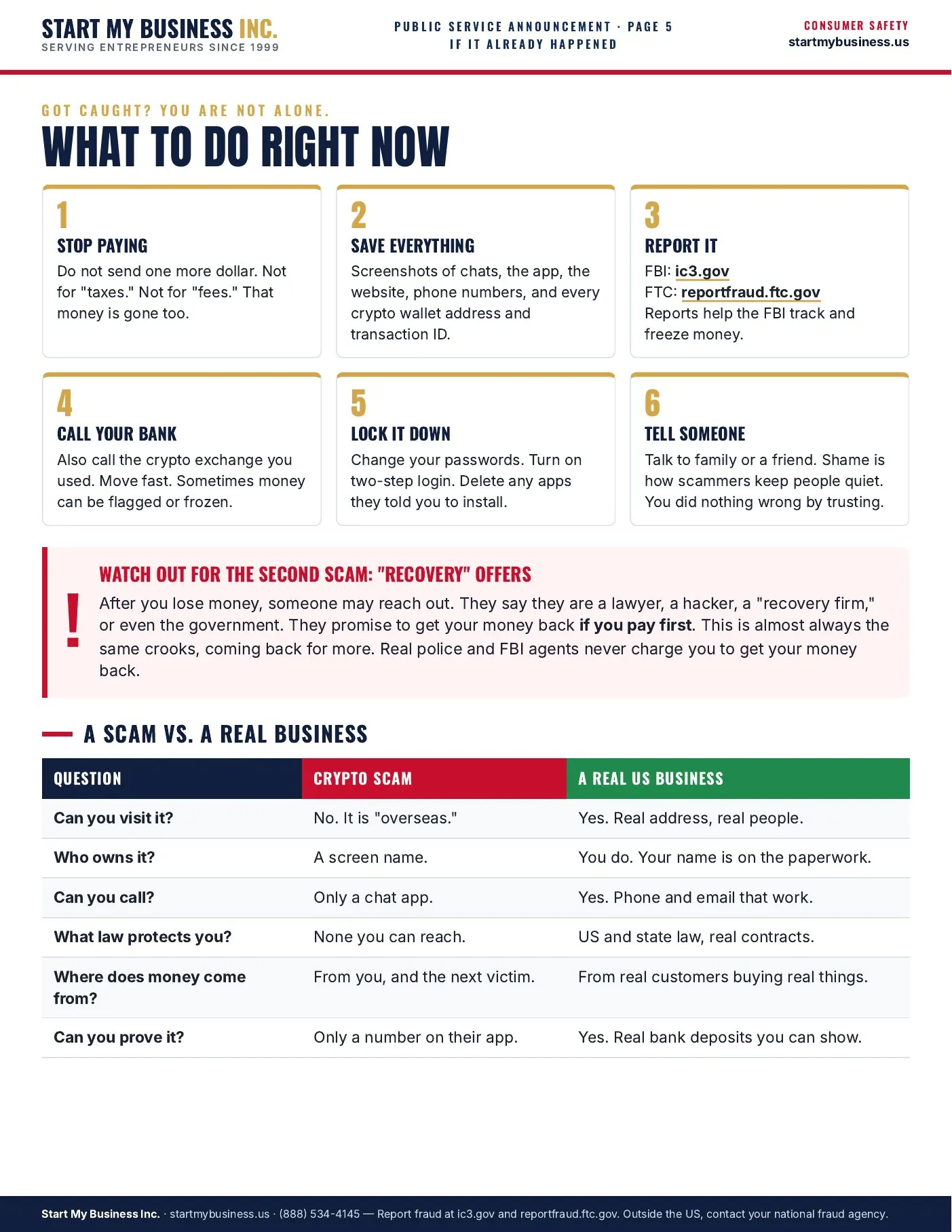


The guide as text
The same guide in plain text, for screen readers and easy copying.
The big payout is the bait. Don't be the pig on their plate.
How the "pig butchering" crypto scam works, the red flags to watch for, and what to do instead. Remember: if you can't visit it, verify it, or call it, don't fund it.
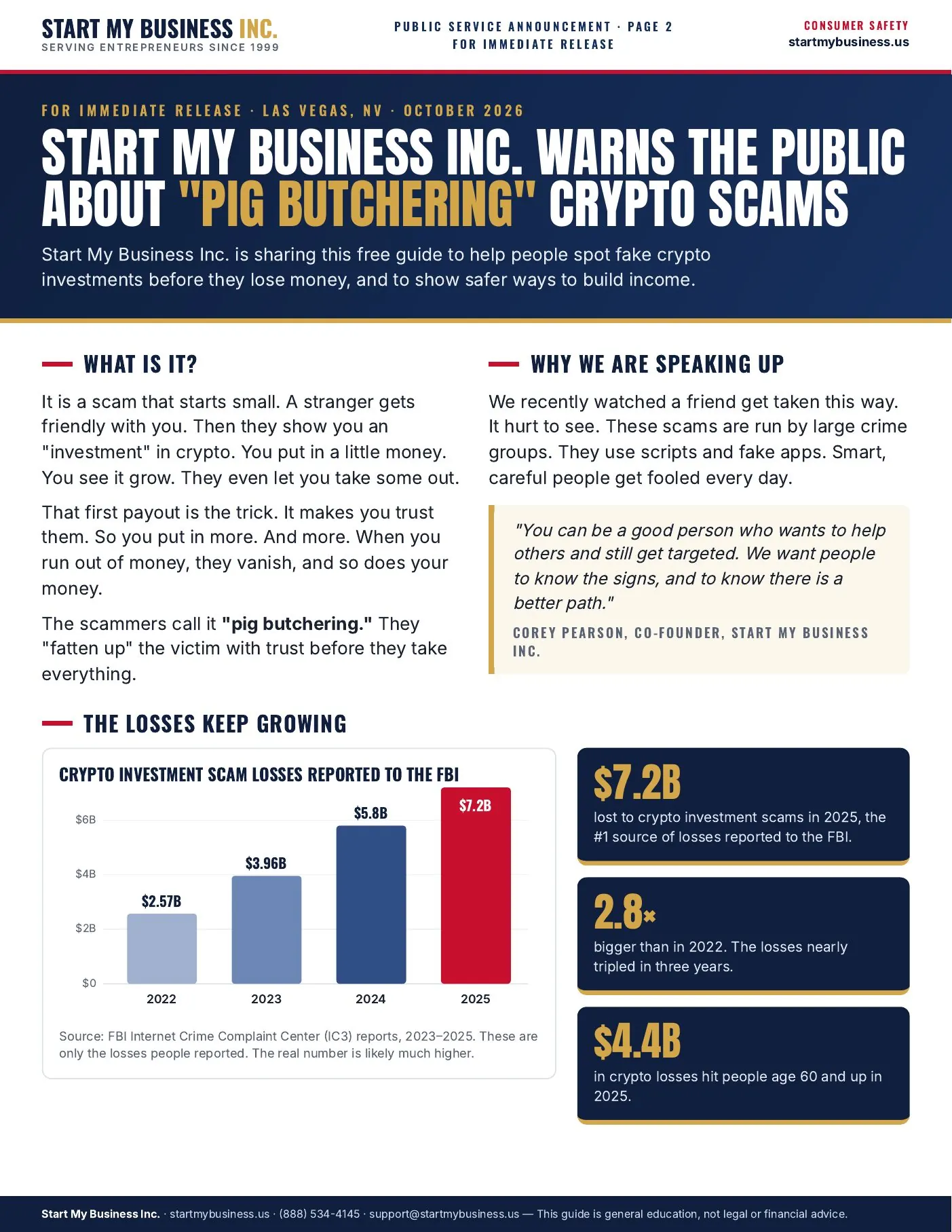
Start My Business Inc. warns the public about "pig butchering" crypto scams
Start My Business Inc. is sharing this free guide to help people spot fake crypto investments before they lose money, and to show safer ways to build income.
What is it?
It is a scam that starts small. A stranger gets friendly with you. Then they show you an "investment" in crypto. You put in a little money. You see it grow. They even let you take some out. That first payout is the trick. It makes you trust them. So you put in more, and more. When you run out of money, they vanish, and so does your money. The scammers call it "pig butchering." They "fatten up" the victim with trust before they take everything.
Why we are speaking up
We recently watched a friend get taken this way. It hurt to see. These scams are run by large crime groups. They use scripts and fake apps. Smart, careful people get fooled every day. As Corey Pearson, co-founder of Start My Business Inc., puts it: "You can be a good person who wants to help others and still get targeted. We want people to know the signs, and to know there is a better path."
The losses keep growing
The guide cites FBI Internet Crime Complaint Center (IC3) reports for 2023 to 2025. Crypto investment scams were the number one source of losses reported to the FBI in 2025, at $7.2 billion. That is 2.8 times bigger than in 2022, so losses nearly tripled in three years. People age 60 and up lost $4.4 billion to crypto scams in 2025. These are only the losses people reported. The real number is likely much higher.

How the trap works, step by step
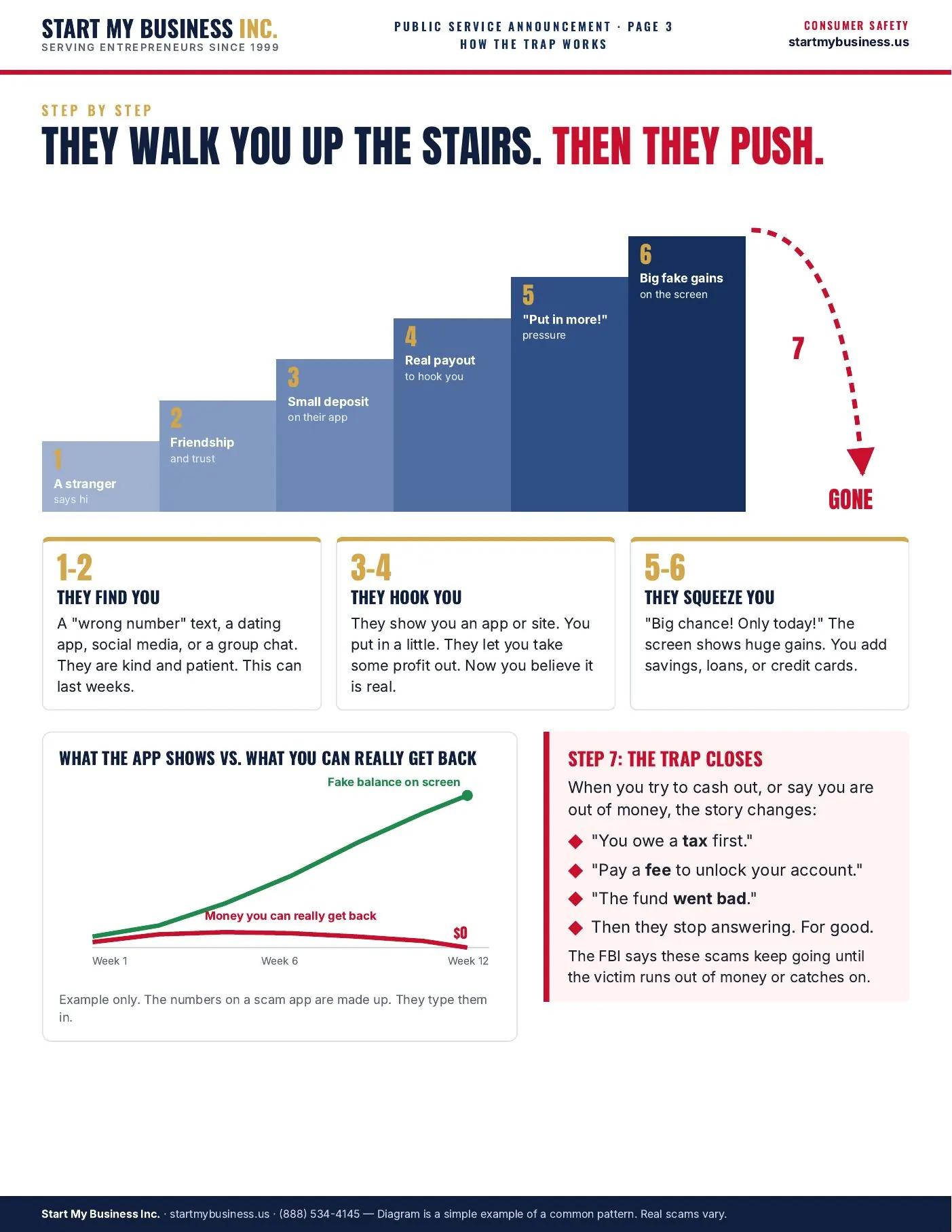
- A stranger says hi. A "wrong number" text, a dating app, social media, or a group chat. They are kind and patient. This can last weeks.
- Small deposit on their app. They show you an app or site. You put in a little.
- Real payout to hook you. They let you take some profit out. Now you believe it is real.
- "Put in more!" pressure. "Big chance! Only today!"
- Big fake gains on the screen. You add savings, loans, or credit cards. The numbers on a scam app are made up. They type them in.
- The trap closes. When you try to cash out, or say you are out of money, the story changes: "You owe a tax first." "Pay a fee to unlock your account." "The fund went bad." Then they stop answering. For good.
The FBI says these scams keep going until the victim runs out of money or catches on.

The red flag list
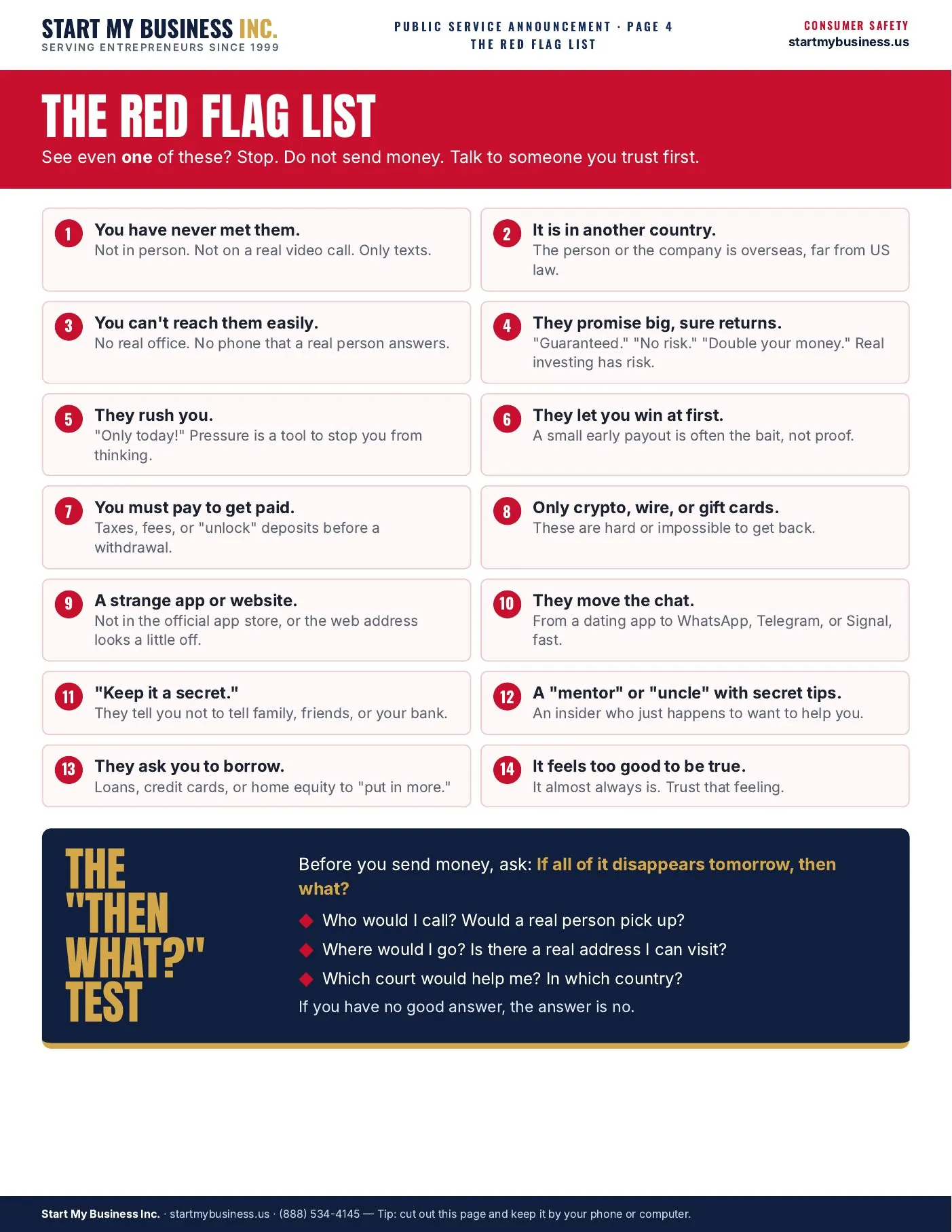
See even one of these? Stop. Do not send money. Talk to someone you trust first.
- You have never met them. Not in person, not on a real video call, only texts.
- It is in another country. The person or the company is overseas, far from US law.
- You can't reach them easily. No real office, and no phone that a real person answers.
- They promise big, sure returns. "Guaranteed." "No risk." "Double your money." Real investing has risk.
- They rush you. "Only today!" Pressure is a tool to stop you from thinking.
- They let you win at first. A small early payout is often the bait, not proof.
- You must pay to get paid. Taxes, fees, or "unlock" deposits before a withdrawal.
- Only crypto, wire, or gift cards. These are hard or impossible to get back.
- A strange app or website. Not in the official app store, or the web address looks a little off.
- They move the chat. From a dating app to WhatsApp, Telegram, or Signal, fast.
- "Keep it a secret." They tell you not to tell family, friends, or your bank.
- A "mentor" or "uncle" with secret tips. An insider who just happens to want to help you.
- They ask you to borrow. Loans, credit cards, or home equity to "put in more."
- It feels too good to be true. It almost always is. Trust that feeling.

The "then what?" test
Before you send money, ask: if all of it disappears tomorrow, then what? Who would I call, and would a real person pick up? Where would I go, and is there a real address I can visit? Which court would help me, and in which country? If you have no good answer, the answer is no.
If it already happened: what to do right now
You are not alone, and you did nothing wrong by trusting.
- Stop paying. Do not send one more dollar. Not for "taxes." Not for "fees." That money is gone too.
- Save everything. Screenshots of chats, the app, the website, phone numbers, and every crypto wallet address and transaction ID.
- Report it. FBI: ic3.gov. FTC: reportfraud.ftc.gov. Reports help the FBI track and freeze money.
- Call your bank. Also call the crypto exchange you used. Move fast. Sometimes money can be flagged or frozen.
- Lock it down. Change your passwords. Turn on two-step login. Delete any apps they told you to install.
- Tell someone. Talk to family or a friend. Shame is how scammers keep people quiet.
Watch out for the second scam: "recovery" offers
After you lose money, someone may reach out. They say they are a lawyer, a hacker, a "recovery firm," or even the government. They promise to get your money back if you pay first. This is almost always the same crooks, coming back for more. Real police and FBI agents never charge you to get your money back. Never pay anyone who promises to "recover" your lost crypto for a fee.
A scam versus a real business
| Question | Crypto scam | A real US business |
|---|---|---|
| Can you visit it? | No. It is "overseas." | Yes. Real address, real people. |
| Who owns it? | A screen name. | You do. Your name is on the paperwork. |
| Can you call? | Only a chat app. | Yes. Phone and email that work. |
| What law protects you? | None you can reach. | US and state law, real contracts. |
| Where does money come from? | From you, and the next victim. | From real customers buying real things. |
| Can you prove it? | Only a number on their app. | Yes. Real bank deposits you can show. |
A better way to build income
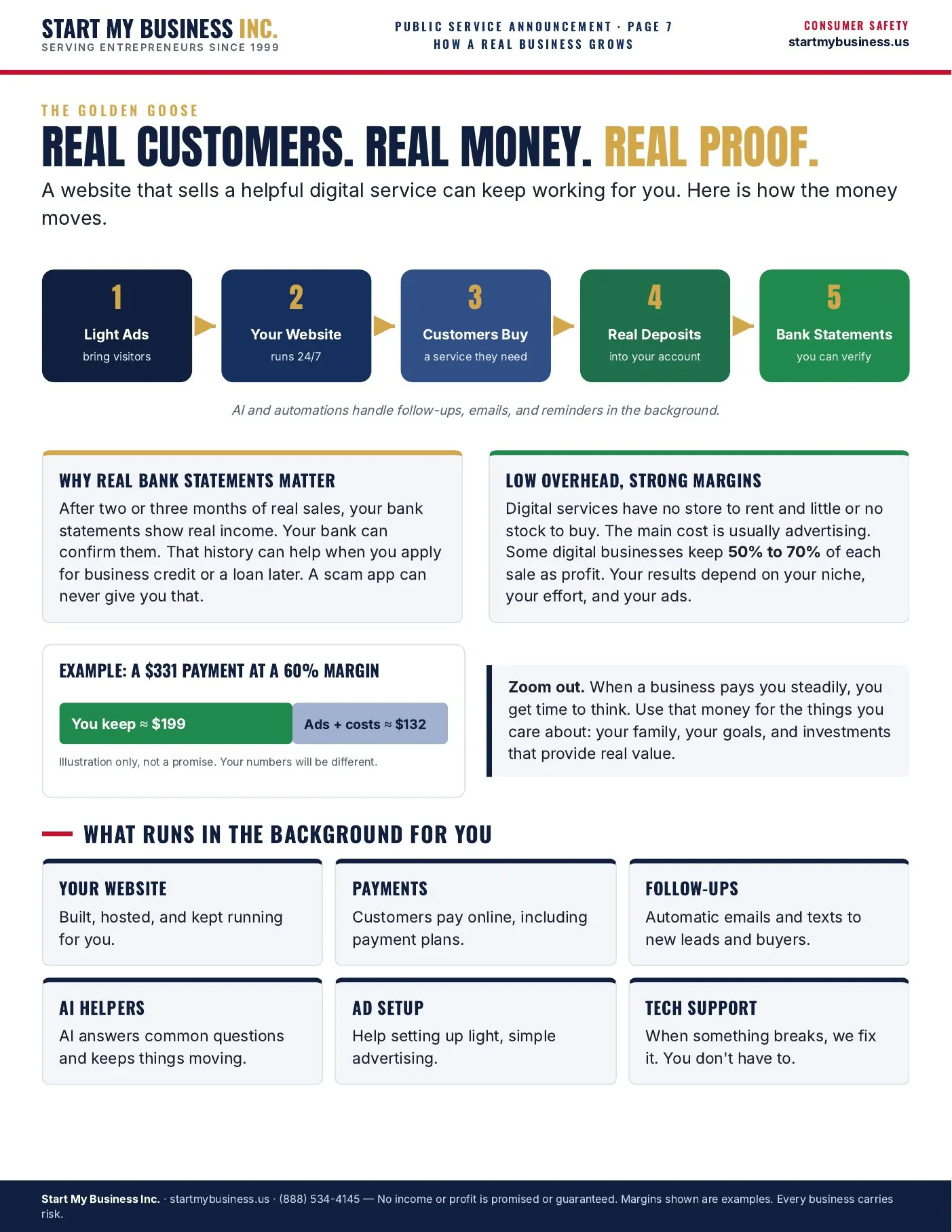
Don't chase a payout. Build something you own. A scam makes you nervous and keeps you guessing. A real business lets you see every step, every sale, and every dollar. Start My Business Inc. has helped people start businesses since 1999. The guide describes about 95% of the work done for you, 100+ proven niches to pick from, and AI and automations running in the background. Results vary and are not guaranteed, and every business carries risk.
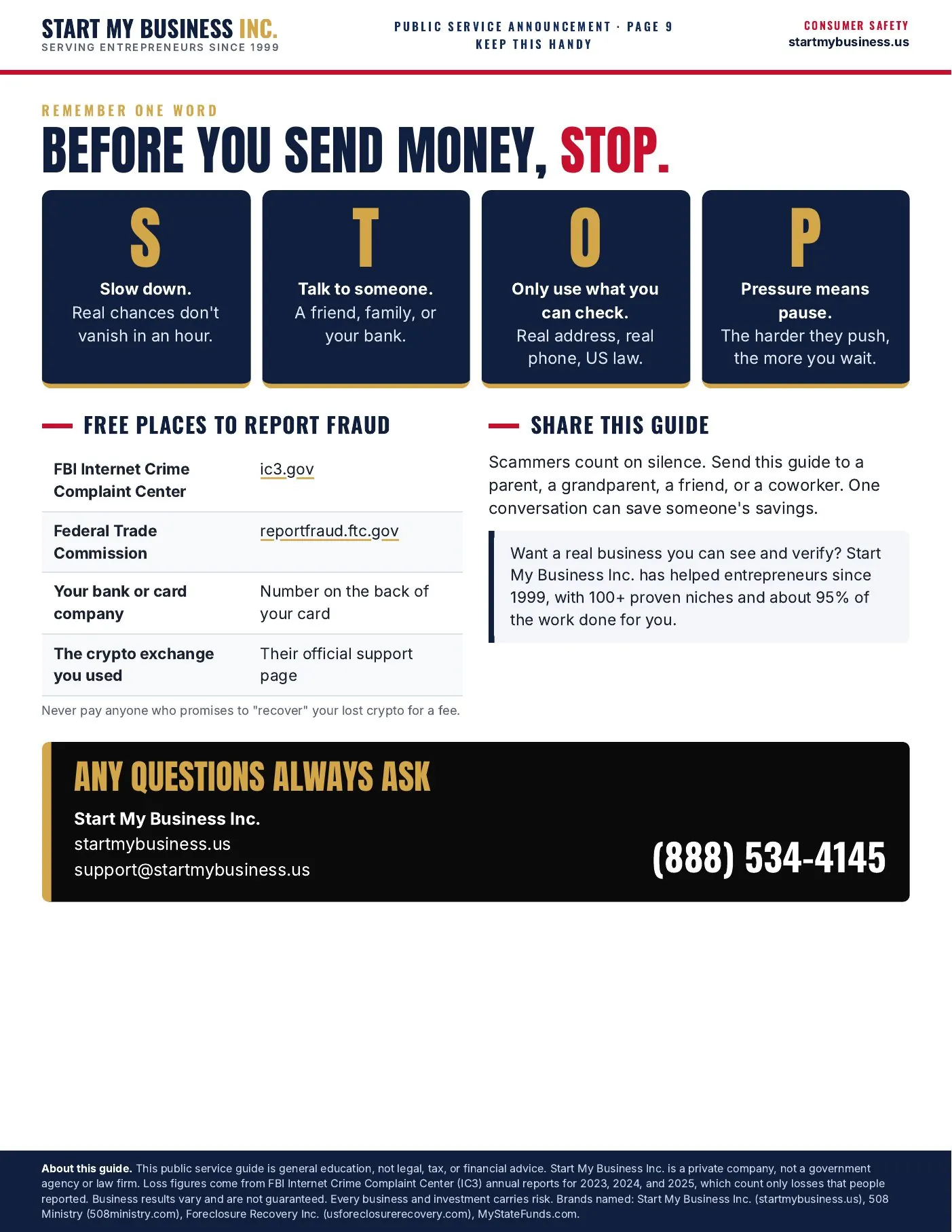
Remember one word: S.T.O.P.
- Slow down. Real chances don't vanish in an hour.
- Talk to someone. A friend, family, or your bank.
- Only use what you can check. Real address, real phone, US law.
- Pressure means pause. The harder they push, the more you wait.
Free places to report fraud
- FBI Internet Crime Complaint Center: ic3.gov
- Federal Trade Commission: reportfraud.ftc.gov
- Your bank or card company: the number on the back of your card
- The crypto exchange you used: their official support page
Scammers count on silence. Send this guide to a parent, a grandparent, a friend, or a coworker. One conversation can save someone's savings.
This public service guide is general education, not legal, tax, or financial advice. Start My Business Inc. is a private company, not a government agency or law firm. Loss figures come from FBI IC3 annual reports and count only losses that people reported.
Quick answers
What is a pig butchering scam?
It is a scam that starts small. A stranger gets friendly with you, then shows you an "investment" in crypto. You put in a little money and see it grow. They even let you take some out. That first payout builds trust, so you put in more. When you run out of money, they vanish, and so does your money.
What are the warning signs of a pig butchering scam?
Red flags include someone you have never met, an app or site that is not in the official app store, promises of big or sure returns, pressure to act today, being asked to pay taxes or fees before you can withdraw, a request to move the chat to WhatsApp, Telegram or Signal, and being told to keep it a secret from family or your bank.
What should I do if I already lost money to a crypto investment scam?
Do not send one more dollar. Save screenshots, wallet addresses and transaction IDs. Report it at ic3.gov and reportfraud.ftc.gov. Call your bank and the crypto exchange you used, change your passwords, turn on two-step login, and tell someone you trust.
Can someone get my crypto back for a fee?
Be careful. After a loss, scammers often return posing as a lawyer, hacker or recovery firm and ask you to pay first. This is almost always the same crooks coming back for more. Real police and FBI agents never charge you to get your money back.
What is the "then what?" test?
Before you send money, ask: if all of it disappears tomorrow, then what? Who would I call, and would a real person pick up? Where would I go, and is there a real address I can visit? Which court would help me, and in which country? If you have no good answer, the answer is no.
Been a victim? Contact us.
You are not alone. Call (888) 534-4145 or send us a message through our contact page. Also report it at ic3.gov and reportfraud.ftc.gov. We will never charge you to "recover" lost crypto.
Share this guide
Scammers count on silence. Send this to someone who needs it.
Build your life and business the right way
Create your free Start My Business account to unlock our library of free guides on building your life and your business the right way.
Create my free accountAlready have an account? Log in here.